
It’s Monday morning. You join a video call with a client in New York, but nobody is there. You check your calendar again. The meeting is still at 3 p.m. in Madrid… but the client’s calendar says something different. What happened?
The answer is simple: the clocks changed in Europe, but not yet in the United States. For a few days, the usual time difference between the two cities is one hour shorter, and everybody’s schedule is a little out of sync.
This Sunday, 25 October 2026, clocks in Spain go back one hour. It happens twice a year, and most people just accept it. But a growing number of people – including the Spanish government – are asking a big question: why do we still do this?
Reading: Spain, the Clock and the Working Day
What actually happens?
Like the rest of the European Union, Spain changes its clocks on two dates every year:
- Last Sunday in March: clocks go forward one hour (summer time begins).
- Last Sunday in October: clocks go back one hour (winter time begins).
This year, at 3 a.m. on Sunday 25 October, the time on the mainland and the Balearic Islands becomes 2 a.m. again. In the Canary Islands, 2 a.m. becomes 1 a.m. The original idea behind summer time was to use more natural daylight in the evenings and save energy.
Spain’s unusual time zone
There is an interesting detail here. If you look at a map, most of Spain is in line with the UK and Portugal. Geographically, its natural time zone is GMT. However, in 1940, during Franco’s dictatorship, Spain moved its clocks forward to Central European Time – the same time as Germany. The change was supposed to be temporary, but it was never reversed.
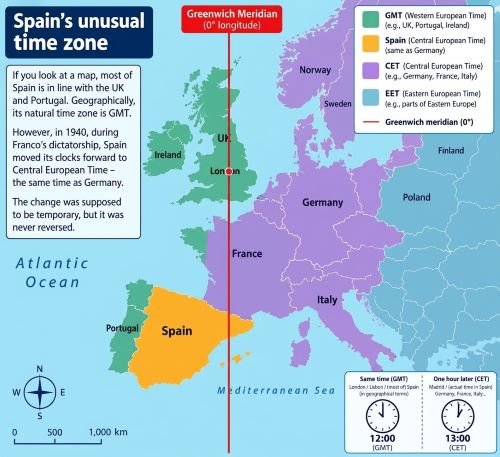
This is one reason why the sun rises and sets quite late in Spain compared with other European countries. Some campaigners believe this helps to explain Spain’s late lunch breaks, late dinners and long working days. Other experts disagree and say that culture, not the clock, is the main reason. It’s a debate without a clear winner.
Want to Know More?
Europe tried to stop it – and then got stuck
In 2018, the European Commission asked citizens for their opinion. About 4.6 million people answered, and 84% said they wanted to stop changing the clocks. In 2019, the European Parliament voted to end the twice-yearly change.
So why are we still doing it? Because the EU countries have never reached an agreement on what should replace it. Should Europe stay on summer time all year, or on winter time all year? Each country has different needs, and nobody wants to end up with a confusing mix of time zones across the continent.
In October 2025, Spain’s Prime Minister Pedro Sánchez described the clock change as obsolete and said Spain would push for the EU to end it. So far, nothing has changed: the European Commission has already published clock-change dates up to 2031.
Why does this matter at work?
For many professionals, the clock change is more than a small annoyance. Here are some arguments on both sides.
Reasons to stop changing the clocks:
- Scheduling problems. Europe and North America change on different dates. For about a week, the time difference with partners in the US or Canada is different from normal, and meetings are easily missed or doubled.
- Tired teams. Many people say they feel tired for a few days after the change, especially in spring when they lose an hour of sleep. Managers may notice a short drop in productivity.
- A weak energy argument. The Spanish government has argued that the energy savings today are very small.
Reasons to be careful:
- Permanent summer time would mean very dark winter mornings, especially in western regions like Galicia. Imagine commuting to work or taking children to school in complete darkness.
- Permanent winter time would mean earlier sunsets in summer. Businesses in tourism, hospitality and retail benefit from long, light evenings, when people go out and spend money.
- Coordination matters. If Spain chose one option and France or Portugal chose another, companies that trade across borders could face new problems.
In other words, every solution comes with a trade-off. The real question is not just “What time is it?” but “Who benefits, and who pays the price?”
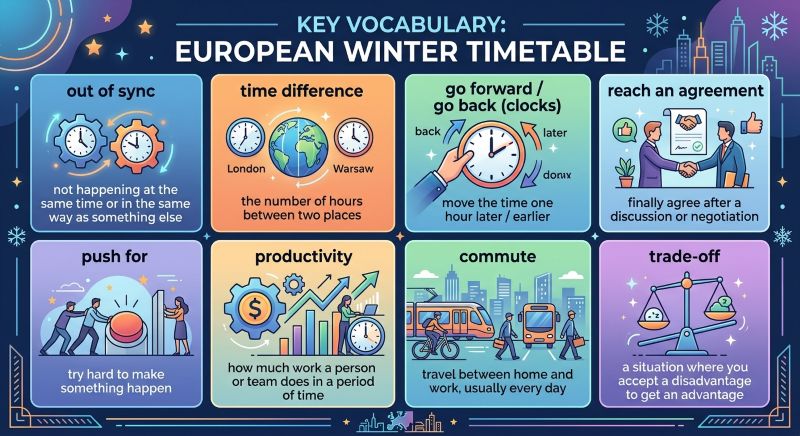
Key Vocabulary
Let's Discuss!
The Clock Change
Final Takeaway
The clock change looks like a small, technical detail. In reality, it touches sleep, money, culture and international business – and it shows how hard it is to make one decision that works for everybody. Next time you put your clocks back, ask yourself a professional question too: when a decision affects many people in different ways, how do you find the best compromise?
