Topic 1.1.1 Strategic Planning C1
STRATEGIC PLANNING
Discussion
What do you know about strategic planning?
What do you think is the purpose of having a plan for a company’s future?
How do you think a company decides what goals it should focus on?
Why do you think it’s important for a company to understand its strengths and weaknesses?
Reading
What is strategic planning?
Strategic Planning is a systematic process that helps an organization define its direction and make decisions on allocating resources to pursue this strategy. It involves setting long-term goals and objectives and developing a coherent plan to achieve them.
Key Components of Strategic Planning:
1.Vision and Mission Statements:
- Vision: Describes what the organization aspires to become in the future.
- Mission: Defines the organization’s purpose and primary objectives.
- SWOT Analysis:
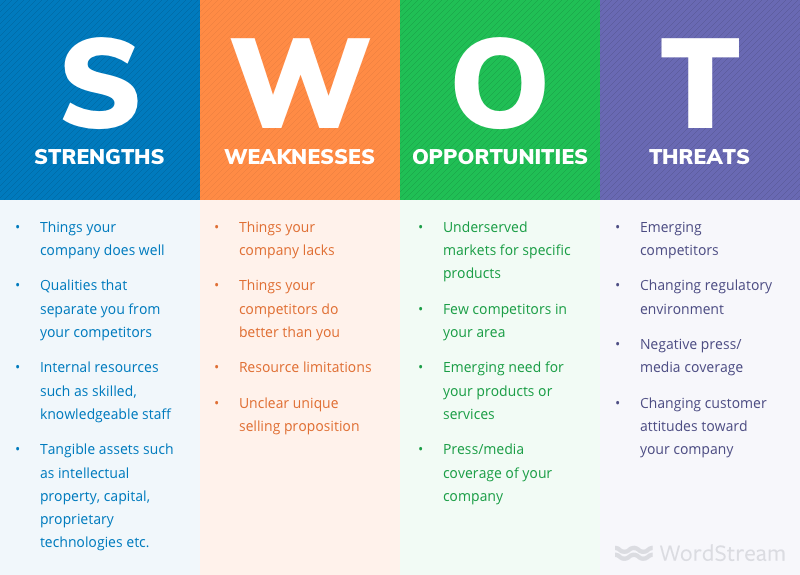
- Analyzes the organization’s internal Strengths and Weaknesses, as well as external Opportunities and Threats.
- Goal Setting:
- Establishing specific, measurable, achievable, relevant, and time-bound (SMART) goals.
- Strategy Formulation:
- Developing strategies to achieve the set goals and objectives.
- Resource Allocation:
- Deciding how to distribute resources (financial, human, etc.) to implement the strategies.
Importance of Strategic Planning:
- Provides direction and focus.
- Facilitates efficient resource allocation.
- Enhances organizational performance.
- Prepares the organization to adapt to changes.
- Encourages proactive management.
Based on the information in the box, discuss the following questions:
- Why are vision and mission statements important, and how do they guide a company’s direction?
- How does a SWOT analysis help a company, and what are examples of strengths, weaknesses, opportunities, and threats?
- What are SMART goals, and why are they important for companies?
- How does strategic planning help a company use its resources well, and what problems might come up?
- How does strategic planning help a company deal with changes, and why is it important to plan ahead for long-term success?
Examples of Vision and Mission Statements

| Vision | “To help people and businesses throughout the world realize their full potential.” |
| Mission | “To empower every person and every organization on the planet to achieve more.” |

| Vision | “To create the most compelling car company of the 21st century by driving the world’s transition to electric vehicles.” |
| Mission | “To accelerate the world’s transition to sustainable energy.” |

| Vision | “To be Earth’s most customer-centric company, where customers can find and discover anything they might want to buy online.” |
| Mission | “To serve consumers through online and physical stores and focus on selection, price, and convenience.” |

| Vision | “To provide access to the world’s information in one click.” |
| Mission | “To organize the world’s information and make it universally accessible and useful.” |

| Vision | “To bring inspiration and innovation to every athlete in the world. (If you have a body, you are an athlete.)” |
| Mission | “To bring inspiration and innovation to every athlete in the world.” |
Discussion
- Does your company have a vision and mission statement?
- If not, how would you describe its vision and mission statement?
SWOT test defined
Discussion
- What is the primary purpose of conducting a SWOT analysis?
- In which scenarios or situations is SWOT analysis particularly useful?
- Which components of SWOT analysis are considered internal factors? Provide examples.
- Which components of SWOT analysis are considered external factors? Provide examples.
- Have you ever had to carry out a SWOT test?
Vocabulary
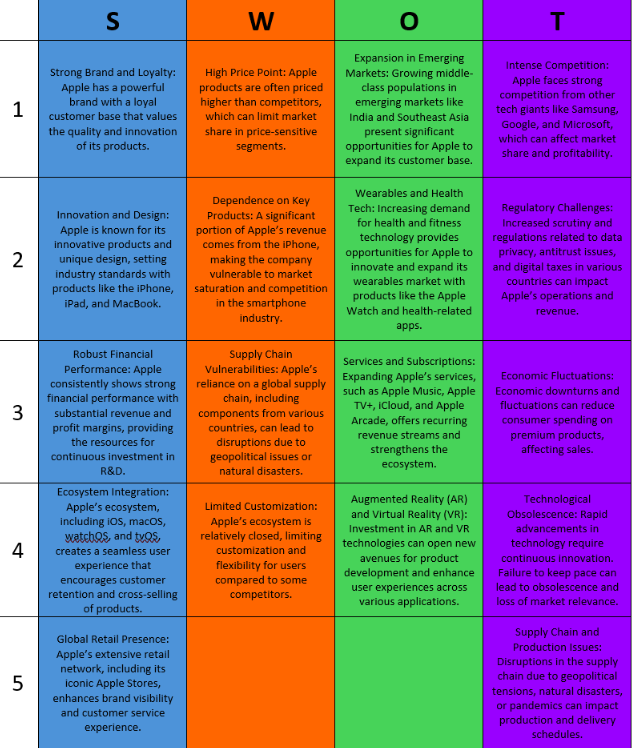
SWOT analysis of Apple Inc.
Look at this SWOT analysis of Apple Inc.
Analyse the chart
- How can Apple capitalize on its strengths to lead in innovation and adapt to market trends?
- What strategies should Apple implement to address its identified weaknesses?
- Which opportunities should Apple prioritize, and why?
- How can Apple effectively defend against external threats identified in the SWOT analysis?
- How can Apple’s corporate strategy align with its SWOT analysis insights?
Complete these words families with words from this Topic.
Discussion questions
Based on the SWOT analysis, what are the key strategic priorities for Apple in the coming years?
How can Apple leverage its strengths to mitigate weaknesses and capitalize on opportunities while managing threats effectively?
What recommendations would you propose for Apple’s strategic direction to sustain growth and innovation in a rapidly evolving tech landscape?
Now in pairs/groups, prepare a SWOT analysis of your company or another company you know.
Homework activities
1.Create a Vision and Mission Statement
Assignment: Choose a fictional or real company and write a vision statement and a mission statement for it.
Objective: Practice crafting clear, inspiring, and purposeful statements that define the company’s direction and goals.
2.Conduct a Mini SWOT Analysis
Assignment: Perform a SWOT analysis for a well-known company or a local business. Identify at least two strengths, weaknesses, opportunities, and threats for the chosen business.
Objective: Develop skills in analysing a company’s internal and external factors that can impact its strategy.
3.Set SMART Goals
Assignment: Set three SMART goals for a project or task you are working on, or for a fictional company. Ensure each goal is Specific, Measurable, Achievable, Relevant, and Time-bound.
Objective: Learn how to create effective goals that are clear and actionable.
4.Design a Strategic Plan Outline
Assignment: Create a basic outline for a strategic plan for a small business or organization. Include sections such as objectives, strategies, action plans, and metrics for success.
Objective: Understand the structure of a strategic plan and the key components involved.
5.Case Study Analysis
Assignment: Read a short case study about a company’s strategic planning process and write a summary. Discuss what the company did well and what could be improved.
Objective: Analyse real-world examples of strategic planning and apply lessons learned to other scenarios.
6.Role-Playing Exercise
Assignment: In a group or as a written exercise, role-play a strategic planning meeting where each participant takes on a different role (e.g., CEO, marketing director, financial advisor). Discuss and negotiate different strategic priorities.
Objective: Experience the dynamics of strategic planning discussions and decision-making.
7.Research and Report
Assignment: Research a company that has successfully navigated a major strategic change (e.g., entering a new market or launching a new product). Write a report on how their strategic planning contributed to their success.
Objective: Learn how companies use strategic planning to adapt and succeed in changing environments.