FULL Period 1 7.2 Planning and Scheduling (Basic Steps) A2
Planning and Scheduling
Discussion: What do you do every day at work? What is your daily routine? Pair up and share your daily routines. While sharing ask each other questions like:
“What is your first task of the day?”
“Which task is most important?”
“Do you have the same routine every day?”
After the group discussion, ask a few students to share their daily routine with the class.
Theory: Planning and Scheduling
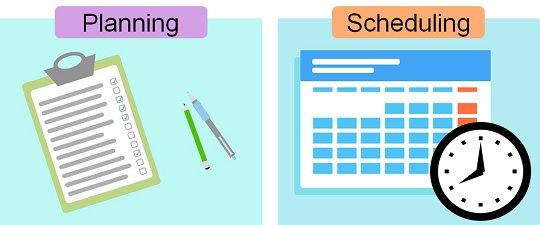
1. What is Planning? Planning is when you decide what you will do during the day or week. You choose your tasks and make a plan to finish them.
Vocabulary:
Plan: A list of things to do.
Task: A job or something you need to do.
Prioritize: To decide which task is most important.
Phrases:
“I need to plan my tasks for the day.”
“I have many tasks, but I will do the important ones first.”
2. What is Scheduling? Scheduling is when you decide when you will do your tasks. You write down the time for each task to help you stay organized.
Vocabulary:
Schedule: A plan with times for each task.
Deadline: The time when something must be finished.
Appointment: A meeting at a specific time.
Phrases:
“I have a meeting at 10 AM.”
“I need to finish the report by 3 PM.”
“Let’s schedule a time to talk tomorrow.”
3. Why is Planning and Scheduling Important?
Stay organized: You know what you need to do.
Save time: You can work faster when you have a plan.
Reduce stress: You don’t forget important tasks.
Finish your tasks on time: You can meet deadlines and complete work.
Vocabulary:
Organized: Everything is in order.
Productive: Getting a lot of work done.
Stress: Feeling worried because of too much work.
Phrases:
“Planning helps me stay organized.”
“If I plan my day, I can be more productive.”
“Scheduling my tasks reduces my stress.”
4. Basic Steps for Planning and Scheduling:
Make a list of what you need to do.
Vocabulary:To-do list: A list of tasks to complete.
Phrase: “I will write a to-do list for today.”
Decide when to do each task.
Vocabulary:Morning, afternoon, evening.
Phrase: “I will work on the report in the afternoon.”
Follow your schedule.
Phrase: “I will check my schedule to see what’s next.”
Review your plan if needed.
Vocabulary:Change, adjust, reschedule.
Phrase: “I need to adjust my schedule because I have a new task.”
Writing Task
Write a paragraph describing their daily work routine. Use at least 3-4 vocabulary words from the lesson and include time expressions.
Example: “I start my day by checking my emails at 9 AM. After that, I have a meeting at 10 AM. In the afternoon, I prioritize writing my report because the deadline is at 3 PM. After lunch, I finish my tasks and schedule the next day’s work.”
Sharing and Feedback
After writing, ask them to exchange their paragraphs with a partner.
Partners read each other’s routines and give simple feedback (e.g., Did they use the vocabulary correctly? Are the time expressions clear?).