
Topic 1.2.1 Writing formal and informal emails
Writing Formal and Informal Emails

Warm up
- How many emails do you receive or write a day?
- Do you ever write or receive any emails in English?
- What are some key differences between formal and informal emails?
- When would you use an informal email instead of a formal one in a business context?
Introductory Activity:
Read the following email
Subject: Project Update and Meeting Schedule
Dear Team,
I hope this email finds you well. Just a quick note to update you on our project progress and to schedule our next meeting.
Firstly, I would like to extend my sincere gratitude to everyone for their hard work and dedication thus far. As you know, we are approaching the deadline, and it is imperative that we maintain our current momentum. I am writing to inform you that we have successfully completed the initial phase of the project. Awesome job, everyone!
Could you please check your calendars and let me know your availability for a meeting next week? I believe it would be beneficial for us to touch base and discuss the upcoming tasks. Let’s catch up and make sure we are all on the same page.
Please find attached the latest project report for your review. If you have any questions or require further information, do not hesitate to reach out to me.
Thank you for your attention to this matter. Looking forward to your responses.
Best regards,
Alex
- Which phrases are formal or informal?
- What do these phrases mean?
- In which context would you use them?

Writing Formal and Informal Emails
1. Purpose and Audience
Formal Emails:
- Purpose: Formal emails are used in professional settings to convey information clearly, maintain professionalism, and ensure proper documentation. They are often used for official communication, such as with clients, superiors, or external stakeholders.
- Audience: Formal emails are typically addressed to individuals with whom you have a professional relationship. This includes colleagues, managers, clients, suppliers, and other business contacts.
Informal Emails:
- Purpose: Informal emails are used for more casual communication, often within the workplace but in less official contexts. They facilitate quick, friendly exchanges and are used when the situation does not require a high level of formality.
- Audience: Informal emails are usually sent to people you have a closer, more familiar relationship with, such as coworkers, friends within the company, or long-term business partners.
2. Structure and Format
Formal Emails:
- Subject Line: Clear and specific, reflecting the content of the email (e.g., “Meeting Request: Q3 Financial Review”).
- Greeting: Polite and professional (e.g., “Dear Mr. Smith,” “Dear Dr. Johnson,”).
- Body:
- Introduction: State the purpose of the email clearly (e.g., “I am writing to inform you…”).
- Main Content: Organized into paragraphs, each focusing on a single point. Use formal language and avoid contractions (e.g., “I would like to request your approval…”).
- Conclusion: Summarize the main points and indicate any required actions or responses (e.g., “I look forward to your response.”).
- Closing: Formal closing phrases (e.g., “Sincerely,” “Best regards,”).
- Signature: Full name, title, and contact information.
Informal Emails:
- Subject Line: Can be more casual but should still be clear (e.g., “Lunch Plans” or “Quick Question”).
- Greeting: Friendly and casual (e.g., “Hi John,” “Hey Sarah,”).
- Body:
- Introduction: Often starts with a friendly opener (e.g., “Just wanted to check in…”).
- Main Content: More relaxed and conversational, may use contractions and colloquial language (e.g., “Can we meet up tomorrow?”).
- Conclusion: Brief and to the point, may end with a casual remark (e.g., “Talk soon,” “Thanks!”).
- Closing: Informal closings (e.g., “Best,” “Cheers,”).
- Signature: First name only, often without additional contact information.
3. Tone and Language
Formal Emails:
- Tone: Professional, respectful, and neutral. Avoids slang, idioms, and overly personal remarks.
- Language: Uses complete sentences, proper grammar, and punctuation. Phrases are polite and precise (e.g., “Could you please…”).
Informal Emails:
- Tone: Friendly, relaxed, and sometimes playful. More personal and can reflect the writer’s personality.
- Language: Can include slang, idioms, and contractions. Sentences may be shorter and less structured (e.g., “Sure thing, let’s do it!”)
[wpdatatable id=63]
[wpdatatable id=64]
Formal Email Example:
Subject: Meeting Request: Q3 Financial Review
Dear Mr. Smith,
I hope this email finds you well.
I am writing to request a meeting to review our financial performance for the third quarter. Please let me know your availability next week so we can schedule a convenient time.
Please find attached the financial reports for your review prior to our meeting. If you have any questions or require further information, do not hesitate to reach out.
Thank you for your attention to this matter. I look forward to your response.
Sincerely,
Alex Johnson Chief Financial Officer [Company Name] [Contact Information]
Can you make this email informal?
Informal Email Example:
Subject: Lunch Plans
Hey Sarah,
Just wanted to check in and see if you’re free for lunch tomorrow. How about we meet at the new café around the corner?
Let me know if that works for you. If not, we can always reschedule.
Thanks!
Best,
Alex
Can you make this email more formal?

Some idioms for formal and informal email writing:
Formal Idioms:
- At your earliest convenience: Used to politely request someone to do something as soon as possible.
- “Please review the attached document and provide your feedback at your earliest convenience.”
- In light of: Considering or because of a particular fact or situation.
- “In light of recent developments, we have decided to postpone the meeting.”
- Touch base: To make contact with someone to discuss or update them on a matter.
- “I wanted to touch base with you regarding the upcoming project deadline.”
- Bring to your attention: To inform someone about something they need to know or consider.
- “I would like to bring to your attention the new company policy on remote work.”
Informal Idioms:
- Drop a line: To send a brief message or update.
- “Just wanted to drop a line to let you know I’ll be out of the office tomorrow.”
- Catch up: To meet or communicate with someone to share recent news.
- “Let’s catch up over a quick call later this week.”
- Give a heads up: To inform someone in advance about something that is going to happen.
- “Just giving you a heads up that I’ll be sending over the report by Friday.”
- Shoot an email: To send an email quickly and informally.
- “If you have any questions, just shoot me an email.”
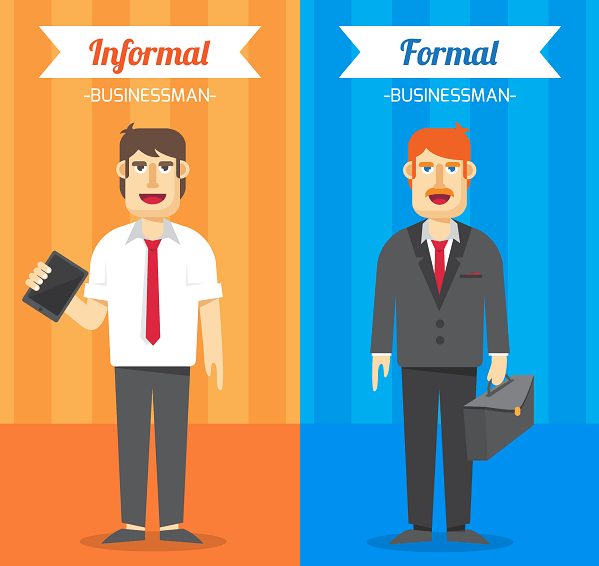

Discussion:
- In which situations do you expect to write formal or informal emails?
- Do you think formality in the workplace is good?
- Do you write more formal or informal emails?
Writing: On a sheet of paper write two short emails: One to your boss and another to a fictitious colleague who works with you. After that compare the emails with your partners.