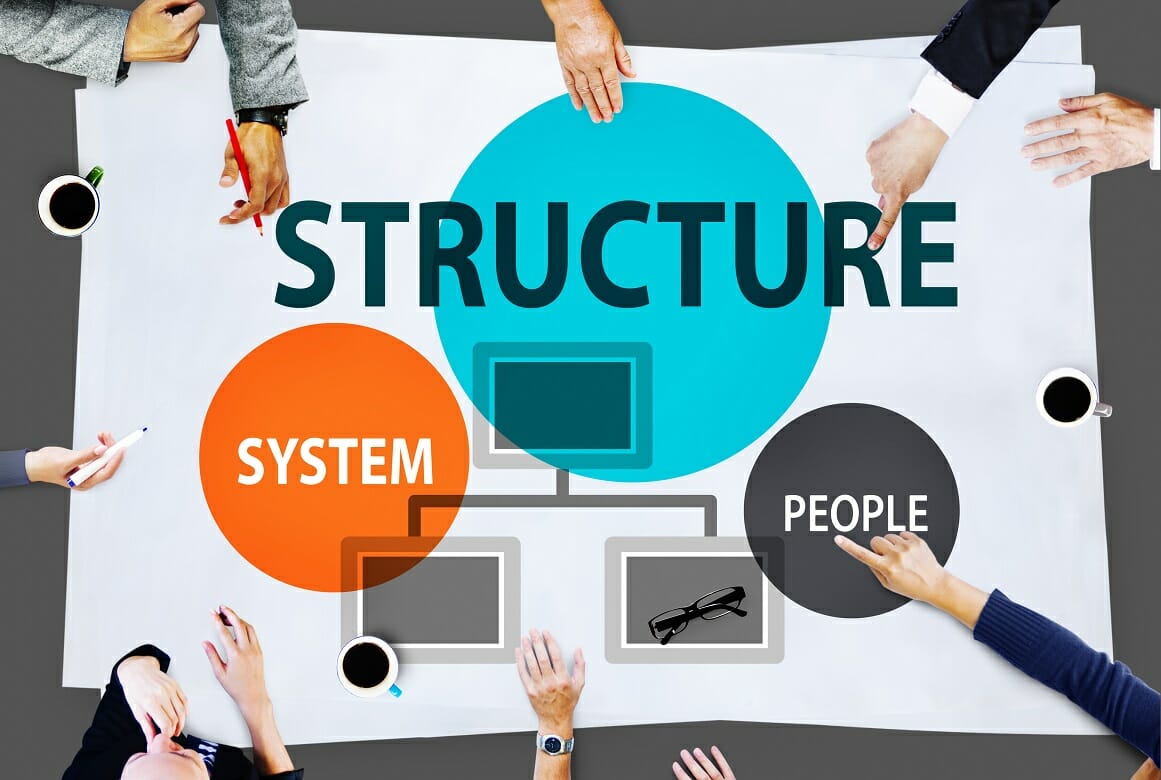
Topic 1.1.1 Company Structures and functions

COMPANY STRUCTURES AND FUNCTIONS

Warm up Activity: Group Discussion.

Discuss in small groups:

“What are the different departments in a company, and what do they do?” Try to focus on the vocabulary you use to describe or name these departments.

Activity 1

Vocabulary:

  • CEO – The highest-ranking executive in a company, responsible for major decisions.
  • Manager – A person responsible for controlling or administering an organization or group of staff.
  • Department – A part of a company that deals with specific tasks or functions.
  • Division – A large unit within a company, often consisting of several departments.
  • Headquarters – The main office or center of operations of a company.
  • Branch – A local office or subsidiary of a company located in a different area from the headquarters.
  • Recruitment – The process of attracting, selecting, and appointing suitable candidates for jobs.
  • Budgeting – The process of creating a plan to spend money within a company.
  • Financial Planning – The planning and management of financial resources to meet a company’s goals.
  • Advertising – The activity of promoting products or services to potential customers.
  • Customer Outreach – Activities aimed at communicating with and supporting existing and potential customers

Types of company Structures:

1. Hierarchical Structure:

  • Definition: A hierarchical structure is a traditional business structure where employees are grouped and assigned a supervisor. It often looks like a pyramid with a few top executives at the top and many employees at the bottom.
  • Characteristics:
    • Clear chain of command.
    • Defined levels of authority and responsibility.
    • Promotion opportunities often based on tenure.
  • Example: Large corporations and government agencies.

2. Flat Structure:

  • Definition: A flat structure has fewer levels of middle management between staff and executives. It encourages a more collaborative and less bureaucratic approach.
  • Characteristics:
    • Greater communication and collaboration.
    • Employees have more responsibility.
    • Decision-making can be faster.
  • Example: Startups and small businesses.

3. Matrix Structure:

  • Definition: A matrix structure combines two or more types of structures, typically functional and project based. Employees report to more than one manager.
  • Characteristics:
    • Flexibility and balanced decision-making.
    • Efficient use of resources.
    • Can be complex due to dual reporting lines.
  • Example: Engineering firms and consultancies.

4. Divisional Structure:

  • Definition: A divisional structure groups each organizational function into a division. Each division operates as a semi-autonomous unit.
  • Characteristics:
    • Focused on product lines, services, or geographical locations.
    • Divisions have their own resources and functions.
    • Better suited for large organizations with diverse products or markets.
  • Example: Multinational corporations.

Discussion

  • What kind of structure do you think your company has?
  • What are the benefits for you/your company of this kind of structure?
  • Which department do you work in?
  • What are your department’s main activities?
  • Which departments do you most often have dealings with
Activity: Read the following text and answer the quiz questions.

Life at GreenTech Innovations

GreenTech Innovations is a growing startup with its headquarters in San Francisco. The company has adopted a flat structure to encourage collaboration and swift decision-making. As a leader in renewable energy solutions, GreenTech Innovations prides itself on its innovative culture and dynamic work environment.

At the top of the organization is the CEO, Sarah Green, who oversees all operations. Despite being the CEO, Sarah maintains an open-door policy, allowing employees from any department to share their ideas directly with her. The company is divided into several key departments, each playing a vital role in its success.

The Human Resources (HR) department is responsible for recruitment, ensuring that the company attracts talented and motivated individuals. They also manage training programs and handle employee relations to maintain a positive workplace atmosphere.

The Finance department handles budgeting and financial planning, ensuring that the company’s resources are managed effectively. This department is crucial for making strategic investment decisions that support the company’s growth.

GreenTech’s Marketing team focuses on advertising and customer outreach. They conduct extensive market research to understand the needs of their clients and create promotional campaigns to drive sales.

In contrast, the Operations department manages the production and delivery of products. They ensure that GreenTech’s solutions meet the highest standards of quality and are delivered on time.

Finally, the IT department supports the technological infrastructure of the company. They handle network management, software development, and data security, ensuring smooth and secure operations across all departments.

GreenTech Innovations also has several branches across the country, allowing them to serve a wider customer base. Each branch operates semi-autonomously but aligns with the overall goals set by the headquarters.

Some Phrasal verbs:

  • Break down: To divide a company into smaller parts or units, often to improve efficiency or focus.
  • “The company decided to break down its operations into regional divisions.”
  • Set up: To establish a new part or unit within a company.
  • “They set up a new marketing department to handle the increased demand.”
  • Cut back: To reduce the size or number of employees or operations within a company.
  • “Due to budget constraints, the company had to cut back on its workforce.”
  • Take over: To gain control of another company or its departments.
  • “The larger corporation took over several smaller businesses to expand its market reach.”
  • Phase out: To gradually discontinue a department, product, or service within the company.
  • “They decided to phase out the old software division as it was no longer profitable.”
  • Spin off: To create a new independent company by separating part of the company’s operations or assets.
  • “The tech giant decided to spin off its cloud services division into a separate entity.”
  • Merge with: To combine with another company or division to form a single entity.
  • “The two firms decided to merge with each other to strengthen their market position.”

Discussion

  1. What are some situations in business where communication can break down, and how can these issues be resolved?
  2. Have you ever been involved in setting up a new process or system at work? What challenges did you face?
  3. In what situations might a company need to cut back on spending? How should they decide where to make cuts?”
  4. Have you ever witnessed or been part of a team that was taken over by another department or company? What was that experience like?
  5. What are some signs that a particular technology or product is being phased out in the market?
  6. Can you think of any shows that spun off from another series and became even more popular, and why do you think they succeeded?
  7. What factors should be considered when two companies are planning to merge with each other?”

Discussion: What do you think of your company’s structure, would you change anything to optimize it? Why or Why not?